Female demon territory
A Werewolf Thing: A Rejected Mate Werewolf RomanceBanshee territory is the hostile domain beyond the boundary of the Færy village, and it gives the novel’s interspecies conflict a concrete geography. It is not merely a neighboring settlement: crossing into it exposes a Færy to shrieks that can defeat or kill them, while Banshees can cross the dividing line more easily. During the abduction of Sondra, this territory becomes the destination of a pursuit in which the boundary determines who can act, who is vulnerable, and how quickly rescue must occur.
Definition and Spatial Relation
Banshee territory is identified with the Banshee village, which lies beyond a boundary located a few miles from the Færy villages. That distance is significant because the pursuit does not end at the initial attack. A Banshee seizes Sondra and carries her toward its own village, turning the intervening ground into a narrowing corridor between rescue and capture. The boundary is therefore both a geographic line and a species-based limit: it separates communities that are natural foes and regulates the movement of their bodies.
The crossing rules are unequal. A Banshee can pass between the territories more easily than a Færy can enter Banshee territory. If a Færy crosses onto the Banshee side, the creatures’ shrieks can readily overcome them. The location consequently functions as a threshold with an unequal cost. It does not offer neutral ground; it gives the Banshees a tactical advantage and makes the Færy village’s border a zone of immediate danger.
The Abduction of Sondra
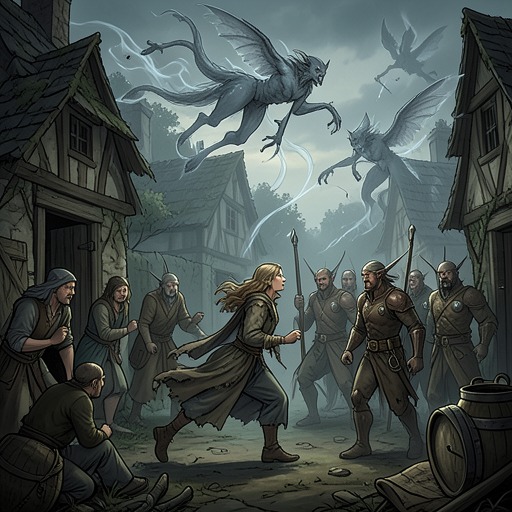
The territory becomes central when Banshees attack the Færy village. Their screams erupt across the settlement, and the narration establishes that prolonged exposure to the high notes can kill. In the confusion, Saphira searches for Sondra, who is expected to become the new leader and therefore must be protected. Saphira finds her curled in a fetal position with her hands pressed over her ears, but a Banshee has already grabbed her by the leg and begun dragging her toward the Banshee village.
The Banshee’s movement toward its territory changes the rescue from a confrontation within the village into a pursuit governed by the border. When the Banshee sees Saphira approaching, it lifts Sondra over its shoulder and sprints away. Saphira follows at heightened speed, but she cannot phase into her wolf form because she has no defense against the Banshees in that form. The nearer the group comes to the boundary, the more urgent the pursuit becomes: they run until they are only a mile away, while Saphira is already suffering the effects of the Banshee’s attack and still insists on recovering Sondra.
Trevor interrupts the flight before the Banshee reaches its village. He tackles the creature, causing Sondra to fall from its shoulder, but the Banshee pushes him away and turns back toward her. Trevor then uses a charm to encircle the Banshee in a tall ring of fire. The flames briefly hold the creature, yet the danger remains when the fire goes out and the Banshee steps toward Saphira, preparing to scream. Before the scream can escape, an arrow strikes it in the head. The Banshee disappears as dust clears, ending the immediate threat before Sondra is carried across the final stretch into its territory.
Boundary, Violence, and Species Conflict
Banshee territory embodies the novel’s practice of turning species difference into environmental danger. The Banshees and the Færy are described as natural foes, and the Banshees’ defining weapon is not a conventional blade or physical attack but a scream whose pitch can kill. Their village is consequently protected by an acoustic threat that follows the characters toward the border. The closer the pursuit comes to Banshee territory, the less useful ordinary speed and physical strength become.
The location also exposes the asymmetry of interspecies mobility. A Banshee can cross boundaries with comparative ease, abduct a Færy, and retreat toward a place where the pursuers are weakened. Saphira’s inability to phase safely and the danger of entering the territory in wolf form show that identity is carried in the body: changing form does not free her from the rules of the hostile space. The boundary thus reinforces social separation through bodily consequences, while the rescue effort challenges that separation by forcing Saphira and Trevor to pursue a victim across its approach.
Narrative Significance
As a setting, Banshee territory is most important as a limit that is nearly reached rather than fully explored. The action remains on the dangerous route toward the village, and the rescue succeeds before Sondra is taken beyond the decisive threshold. This gives the boundary suspenseful force: the location governs the scene even while the narrative withholds a sustained passage inside it.
The territory’s significance extends beyond the Banshee attack. Elsewhere, the story repeatedly places characters in contested spaces, including another pack’s territory, a dark storage room, and an island reached through sand and an unfamiliar landscape. In each case, location determines access, vulnerability, and the possibility of escape. Banshee territory is the clearest example of that pattern because its boundary is explicitly measured, its crossing conditions are unequal, and its danger is tied to the species of the person attempting to pass.
The rescue also gives the place a lasting association with protection and cost. Saphira enters the pursuit knowing that the Banshee’s shrieks can defeat her, Trevor intervenes with a magical charm, and the final killing shot comes from Ashton, who arrives injured and carrying a crossbow. Banshee territory therefore marks the point at which communal defense, personal loyalty, magic, and violence converge. It is a borderland where the story’s categories—Færy and Banshee, safe village and hostile village, rescue and abduction—become immediate physical choices.